


Best smart glasses of 2026: Ray-Ban Meta, Meta Ray-Ban Display, Even G2 and Xreal
Camera glasses, display glasses and audio glasses compared on what they can do, price, battery life, where you can buy them and the privacy questions they raise
On this page
- Best smart glasses: quick picks
- What can smart glasses actually do?
- 1. Ray-Ban Meta (Gen 2): the best smart glasses for most people
- 2. Ray-Ban Meta (Gen 3): best Ray-Ban styles and battery life
- 3. Meta Glasses: the cheapest camera glasses
- 4. Oakley Meta Vanguard and HSTN: best for sport
- 5. Meta Ray-Ban Display: the best smart glasses with a display
- 6. Even Realities G2: best display glasses without a camera
- 7. Ray-Ban Meta Audio: smart glasses with no camera
- 8. Xreal 1S and One Pro: best display glasses for video
- What about Android XR glasses from Google and Samsung?
- Smart glasses and privacy: what to know
- Where can you buy smart glasses?
- Frequently asked questions
The best smart glasses for most people in November 2026 are still Meta's Ray-Ban glasses. The new Ray-Ban Meta (Gen 3) costs $449 and adds an hour of battery life, but the Gen 2 is still on sale at $379 and does almost everything the same: a 12MP camera, open-ear speakers and Meta AI, with no screen. If you want a display in your lens, the Meta Ray-Ban Display ($799 with its Neural Band wristband) is the most capable you can buy. Since September you can order it online in the US, and it's now sold in Canada, the UK, France, Italy and Germany too.
Everything else depends on what you want the glasses to do. Even Realities' G2 ($599) shows text in both lenses with no camera at all. Xreal's 1S ($449) is a wired screen for watching video or working on a laptop. Google's first Android XR glasses opened for pre-order on 12 November but don't ship until 10 December, so they're not on this list yet.
Best smart glasses: quick picks
| Glasses | Best for | Starting price | Camera | Display | Claimed battery | Where to buy |
|---|---|---|---|---|---|---|
| Ray-Ban Meta (Gen 2) | Most people | $379 | 12MP, 3K video | No | Up to 8 h | Many countries |
| Ray-Ban Meta (Gen 3) | Best Ray-Ban styles | $449 | 12MP, 3K video | No | Up to 9 h | Many countries |
| Meta Glasses (Adventurer) | Cheapest camera glasses | $249 | Yes | No | Over 8 h | Several countries |
| Oakley Meta Vanguard | Sport and training | $499 | 12MP, 3K video | No | Up to 9 h | Oakley Meta markets |
| Meta Ray-Ban Display | A screen in your lens | $799 with Neural Band | Yes | Yes, right eye only | Up to 6 h | US, Canada, UK, France, Italy, Germany |
| Even Realities G2 | Discreet notes and translation | $599 | No | Yes, both eyes, green text | Up to 2 days | Online |
| Ray-Ban Meta Audio | No camera, just audio and AI | $349 | No | No | Up to 12 h | US (other markets unconfirmed) |
| Xreal 1S | Watching video, a big virtual monitor | $449 | No | Yes, wired | Powered by your device | Online |
What can smart glasses actually do?
They fall into four groups, and it helps to know which you're shopping for.
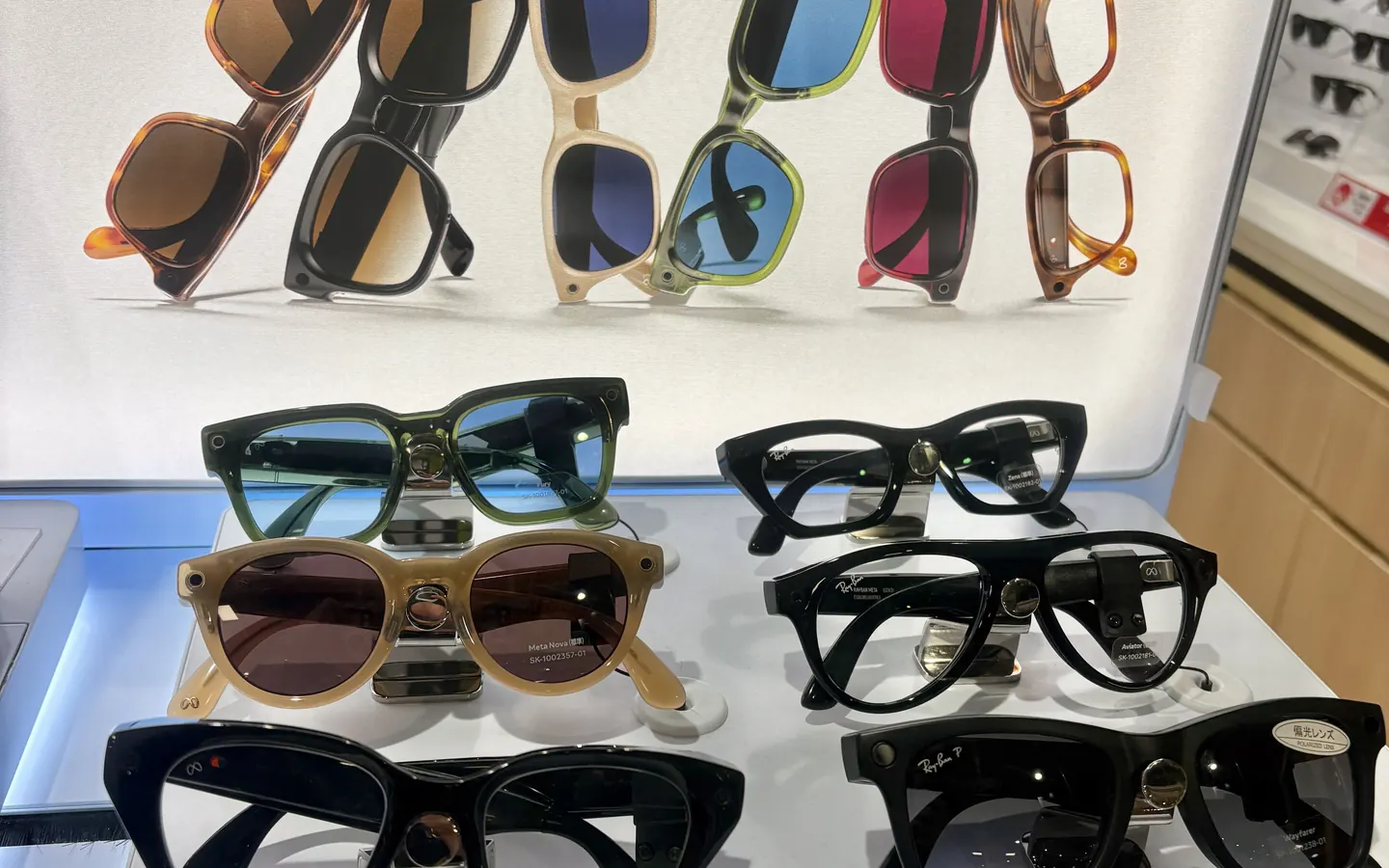
- Camera and AI glasses (Ray-Ban Meta, Oakley Meta, Meta Glasses). No screen. They take photos and video from your point of view, play music through open-ear speakers, handle calls and let you ask Meta AI about what you're looking at.
- Heads-up display glasses (Meta Ray-Ban Display, Even Realities G2). A small image appears in the lens for messages, directions, captions and translations. Meta's has a camera; Even's deliberately doesn't.
- Audio glasses (Ray-Ban Meta Audio). Speakers, microphones and an assistant, with no camera, so they can't record anyone.
- Display glasses for media (Xreal 1S, Xreal One Pro, Xreal Aura). These plug into a phone, laptop or console and show a large virtual screen. They're for watching and working, not wearing all day.
1. Ray-Ban Meta (Gen 2): the best smart glasses for most people
The Gen 2 launched in September 2025 at $379 and is still sold at that price alongside the Gen 3. (Engadget's Gen 3 review lists it at $349, but Meta's lineup page and US retailers in November still showed $379.) Meta says its battery lasts about twice as long as the first generation's.
- What they do: 12MP photos and 3K video at up to 60 frames per second; open-ear speakers; Meta AI by voice; music, calls and messages.
- Battery: Up to 8 hours of typical use, with 48 more hours from the case, Meta says. A 50% charge takes about 20 minutes.
- Prescriptions: Meta's Blayzer and Scriber Optics (Gen 2) frames, from $499, are designed for prescription lenses and support nearly all prescriptions, Meta says.
- Main strength: The Gen 3's camera and nearly all its features for $70 less.
- Main weakness: No screen, and everything runs through Meta's app and Meta AI.
Buy them if you want hands-free photos, music and an assistant in normal-looking frames, and don't need the newest styles.
2. Ray-Ban Meta (Gen 3): best Ray-Ban styles and battery life
Meta launched the Gen 3 at Connect on 23 September 2026. The Wayfarer starts at $449, while the new Zena cat-eye and reworked Aviator start at $529, an $80 premium Engadget's reviewer didn't love.
- What's new: Slimmer frames, 27 color and lens combinations, a customizable action button, a six-microphone array for better calls, and Meta's new Muse Spark model behind Meta AI, which Engadget found more natural to talk to. The camera is the same 12MP with 3K video.
- Battery: Up to 9 hours, one hour more than the Gen 2, Meta says. Engadget got about six hours of continuous audio playback, and found live AI drains it faster.
- What reviewers found: Engadget scored them 7.3/10, calling the upgrades minor and noting the bulkier Aviator frames kept slipping down the reviewer's nose. You also can't adjust the fit yourself; that needs an optician or a Meta store.
- Main strength: The best-looking, longest-lasting Ray-Ban Meta yet.
- Main weakness: Not enough new over the Gen 2 to justify $70 more for most people.
Buy them if you want the Zena or new Aviator styles, or the extra hour of battery.
3. Meta Glasses: the cheapest camera glasses
In June 2026 Meta started selling its own-brand glasses, made with EssilorLuxottica but without Ray-Ban or Oakley branding, from $299. At Connect in September it added a black Meta Adventurer with grey lenses from $249, on sale since 23 October, which is now the cheapest way into Meta's camera glasses.
- What they do: A camera, personal speakers, Meta AI on a dedicated button that you can remap, and live translation with 14 more languages, TechCrunch reported at launch. No display.
- Battery: Over 8 hours, plus up to 40 hours from the case.
- Main strength: The core Meta experience for $130 less than a Ray-Ban Gen 2.
- Main weakness: Fewer classic frame styles, and Meta hasn't published a full spec sheet comparing them with the Ray-Bans.
4. Oakley Meta Vanguard and HSTN: best for sport
Meta's Oakley line splits in two. The Oakley Meta HSTN (from $399) is an everyday sporty frame with IPX4 splash resistance and up to 8 hours of battery. The Oakley Meta Vanguard ($499, on sale since October 2025) is the serious training pair.
- Vanguard specs: A centered 12MP camera with a 122-degree lens and 3K video; IP67 water and dust resistance, the highest of any Meta glasses; up to 9 hours (6 hours of continuous music), with 36 more hours from the case; louder open-ear speakers.
- Integrations: Garmin watches for heart rate and pace on request, Strava for overlaying workout stats on your videos, plus Apple Health and Health Connect, according to Meta.
- Main strength: Built for sweat, rain and speed, with real fitness data.
- Main weakness: The wraparound look isn't for everyday wear.
Buy them if you run, ride or train outdoors. If you mainly want fitness tracking, a watch does more; see our best smartwatches guide.
5. Meta Ray-Ban Display: the best smart glasses with a display
Meta's first display glasses went on sale in the US on 30 September 2025 at $799, including the Meta Neural Band, a wristband that reads tiny muscle movements so you can control the glasses with finger gestures. They're still Meta's top model in its 2026 lineup.
- The display: A full-color screen in the right lens only, which UploadVR measured at 600 x 600 pixels with a 20-degree diagonal field of view and up to 5,000 nits. Only 2% of the light leaks forward, so people around you can't see it.
- What they do: Messages, video calls, directions, live captions of the person you're facing, live translation, a camera viewfinder, and "neural handwriting," which since May 2026 lets every owner write replies by tracing letters with a finger, in WhatsApp, Messenger, Instagram and the phone's own messaging app, Digital Trends reported.
- Battery and weight: Up to 6 hours of mixed use and 30 hours with the case; up to 18 hours for the Neural Band, Meta says. They weigh 69g, against 52g for a Ray-Ban Meta.
- What reviewers found: UploadVR's November 2025 review called them a first-generation product. It praised the sharp, bright display, the captions and the near-perfect gesture accuracy, but found the one-eyed display caused eyestrain, video calls stuttered over Bluetooth, navigation only worked in 28 cities, and there were no third-party apps. Since then Meta has added cycling and transit directions in the US and Canada and opened the glasses to developers' web apps, though navigation still covers only selected cities, UploadVR reported in September.
- Availability: At first Meta sold them only through US stores such as Best Buy, LensCrafters, Sunglass Hut and Ray-Ban, with a demo first. After delaying its international rollout in January, Meta started online ordering in the US on 23 September 2026 and began selling them in Canada (CA$1,149) and the UK (£749) the same day. France, Italy and Germany (€899) followed on 13 October.
- Main weakness: Price, the monocular screen, and one more device (the band) to charge.
Buy them if you want to glance at messages and directions without taking out your phone. A demo is still worth booking, since fit and band sizing matter.
6. Even Realities G2: best display glasses without a camera
The Even G2 ($599) takes the opposite approach to Meta. There's no camera and, TechCrunch notes, no speakers either, by design. Instead you get a green heads-up display in both lenses for notes, notifications, translation, a teleprompter and live transcription of conversations.
- Specs: Micro LED display at 640 x 350, a 27.5-degree field of view, 60Hz and 1,200 nits, per Even Realities; 36g; IP65; up to two days of battery, with seven more charges from the case. Prescription lenses from -12.00 to +12.00 start at $159 extra.
- What reviewers found: TechCrunch's reviewer found the frames comfortable and translation useful, but Even's AI assistant often misunderstood requests, the navigation feature didn't use Google or Apple Maps, and the optional $249 R1 ring wasn't worth the money.
- Main strength: Looks and weighs like ordinary glasses, and nobody can worry you're filming them.
- Main weakness: The software still needs work, and you'll need earbuds for audio. Our best wireless earbuds guide covers good pairs.
Buy them if you give talks, take meeting notes or travel, and want a display without a camera.
7. Ray-Ban Meta Audio: smart glasses with no camera
Meta's camera-free glasses went on pre-order at Connect from $349 and began shipping on 13 October 2026, in Clubmaster and Burbank styles with 23 color and lens combinations. Meta's announcement gave only a US price. With no camera, they can't record the people around you, and TechCrunch links them to the privacy backlash against Meta's camera glasses.
- What they do: Music, calls and Meta AI through open-ear speakers and six microphones. TechCrunch reports they'll work with Muse, Meta's new personal AI agent.
- Battery and weight: Up to 12 hours, plus 48 hours from the case; 43g, Meta says.
- Main strength: The longest battery life in Meta's range, with none of the camera concerns.
- Main weakness: Without a camera, Meta AI can't see what you're looking at.
8. Xreal 1S and One Pro: best display glasses for video
Xreal's glasses aren't for wearing around town. They connect to a phone, laptop, handheld or console with a cable and show a large virtual screen. The Xreal 1S lists at $449 with a 1200p Sony micro-OLED display at 120Hz, 700 nits and 82g, according to Xreal. The One Pro lists at $599.
At the top of the range, the Xreal Aura ($1,279 with 12GB and 256GB, or $1,499 with 16GB and 512GB) brings Google's Android XR to see-through glasses, with a wired compute puck, a 70-degree field of view and hand tracking. Xreal opened orders on 28 October for US, Canadian, Japanese and South Korean buyers, with launch set for mid-November. 9to5Google's early review found it light compared with headsets but suited to a narrow audience: travel viewing, wired screen mirroring and offline media rather than gaming or serious productivity.
Buy an Xreal if you want a private big screen on a plane or a portable monitor for a laptop.
What about Android XR glasses from Google and Samsung?
They're close, but not shipping. Google's first "Intelligent Eyewear," engineered by Samsung and sold under Warby Parker (from $395) and Gentle Monster (from $449) brands, opened for pre-order on 12 November 2026 and ships on 10 December, 9to5Google reports. These first models have a 12MP camera, Gemini, up to nine hours of battery and no display, and they work with iPhones as well as Android phones. Gentle Monster's version, sold in the US and South Korea, sold out within days. Google hasn't given a date for display models.
Samsung's own version is reportedly due in mid-December in the US and South Korea, with no price announced. Snap's Specs AR glasses ($2,200) are taking pre-orders, and Meta has announced VR glasses for next spring from $1,299.99. Apple has announced nothing; TechCrunch reported in April that it's testing designs.
Smart glasses and privacy: what to know
Camera glasses raise real questions, for you and for the people around you.
- The recording light. Meta's glasses show a small LED when recording, and already refused to record if you covered it. Cheap mods that disabled the light circulated in 2025, so in July 2026 Meta pushed an update that shuts the camera off if the LED has been tampered with or destroyed, 9to5Google reported.
- The backlash. TechCrunch reported in September that Meta was preparing camera-free glasses after complaints that it was selling "pervert glasses." Ray-Ban Meta Audio is Meta's camera-free response, and Even Realities has built the G2 around having no camera at all.
- Different rules from Google. 9to5Google reports that Android XR glasses check their recording light regularly and disable the camera if it fails, blur faces on your phone before sending a photo to Gemini, delete Gemini camera captures after use, and cap videos at 90 seconds, against up to five minutes on Meta's glasses.
- Your own data. Asking an assistant about what you see sends images and voice to the company's servers. Read the privacy settings in the companion app, and turn off anything you don't need. If you're trying to reduce how much one company knows about you, our guide on how to de-Google your life covers the bigger picture.
Be considerate: take the glasses off in places where you wouldn't hold up a phone camera, such as changing rooms, schools, hospitals and courts.
Where can you buy smart glasses?
Availability varies more than with phones.
- Ray-Ban Meta and Oakley Meta are sold across North America, much of Europe and Australia, with more markets added in 2026. Meta said in September that Ray-Ban Meta and Oakley Meta would reach Turkey, Poland, Portugal, Israel, South Africa, Indonesia, Thailand, Hong Kong, New Zealand, Malaysia and the Philippines later this year.
- Meta Glasses launched in several countries in June, and in Singapore, South Korea, Mexico and the UAE in September, with Brazil next.
- Meta Ray-Ban Display is sold in the US, Canada, the UK, France, Italy and Germany, online and through selected stores that offer demos and fittings.
- Xreal Aura launched in the US, Canada, Japan and South Korea, with a wider rollout planned for 2027.
- Android XR glasses are on pre-order in the US, with Gentle Monster also selling in South Korea.
Frequently asked questions
What are the best smart glasses in 2026?
The Ray-Ban Meta (Gen 2) at $379 for most people, or the Gen 3 at $449 for the newest styles. For a built-in display, the Meta Ray-Ban Display ($799) is the most capable option on sale.
How much is the Meta Ray-Ban Display, and where can you buy it?
It costs $799 in the US, including the Meta Neural Band, and you can now order it online or buy it in selected stores. It's also sold in Canada (CA$1,149), the UK (£749), and France, Italy and Germany (€899).
Are Android XR glasses available yet?
Not quite. Google's Intelligent Eyewear from Warby Parker and Gentle Monster went on pre-order on 12 November 2026, from $395, and ships on 10 December. Samsung's version is reportedly due in mid-December.
Do smart glasses record people without them knowing?
They can, which is the main privacy concern. Meta's glasses show an LED while recording and now disable the camera if it's tampered with, and Google's glasses also check their light. If that worries you, camera-free models such as the Even G2 and Ray-Ban Meta Audio can't record at all.
How long does smart glasses battery last?
Most camera glasses claim 8 to 9 hours of typical use, with several more charges in the case. Engadget got about six hours of continuous audio from the Ray-Ban Meta Gen 3, and the Meta Ray-Ban Display is rated at up to 6 hours of mixed use.
Can you get smart glasses with prescription lenses?
Yes. Meta's Blayzer and Scriber Optics frames (from $499) are designed for prescriptions, and the Even G2 takes prescriptions from -12.00 to +12.00 for $159 extra.
Sources
- Introducing Ray-Ban Meta Audio and more AI glasses styles, Meta
- Which AI glasses are right for you?, Meta
- Introducing our first AI glasses built for prescriptions, Meta
- Ray-Ban Meta (Gen 2) now with up to 2x the battery life, Meta
- Meta Ray-Ban Display: AI glasses with an EMG wristband, Meta
- Making Meta Ray-Ban Display more useful to more people, Meta
- New features for Meta Ray-Ban Display, Meta
- Ray-Ban Meta (Gen 3) review, Engadget
- Ray-Ban Meta Gen 3 vs Gen 2, Engadget
- Ray-Ban Meta Gen 2 Wayfarers get a modest discount at Amazon, The Gadgeteer
- Meta Ray-Ban Display review, UploadVR
- Meta Ray-Ban Display gets new features, online ordering and international launch, UploadVR
- Meta delays Ray-Ban Display global rollout, CNBC
- Meta's Ray-Ban Display now types messages from your finger movements, Digital Trends
- Meta smart glasses privacy light camera update, 9to5Google
- Oakley Meta HSTN glasses now shipping, UploadVR
- Meta unveils the Oakley Meta Vanguard, TechCrunch
- Meta debuts new, cheaper smart glasses under its own brand, TechCrunch
- After accusations of selling "perv glasses," Meta prepares a pair without a camera, TechCrunch
- At Meta Connect, the company's smart glasses were everywhere, TechCrunch
- Meta is trying VR glasses (again), TechCrunch
- Smart glasses without a camera? Even Realities bets on productivity, TechCrunch
- Even G2 smart glasses, Even Realities
- Even G2 A, Even Realities
- Even G2 smart glasses with 1,200-nit micro LED display now available, Notebookcheck
- Xreal US store, Xreal
- Xreal 1S, Xreal
- Xreal Aura is coming in November, 9to5Google
- Xreal Aura review, 9to5Google
- Google Intelligent Eyewear opens for pre-order, 9to5Google
- Google Android XR glasses camera and privacy, 9to5Google
- Google and Samsung Android XR glasses hands-on, 9to5Google
- Gentle Monster Intelligent Eyewear sold out, 9to5Google
- Samsung's Android XR Intelligent Eyewear reportedly launches in December, 9to5Google
- Android XR at I/O 2026, Google
- Snap Specs hands-on, UploadVR
- Snap's Specs are a lot more comfortable than they used to be, TechCrunch
- Apple reportedly testing four designs for smart glasses, TechCrunch
Was this helpful?
Thanks, noted. It helps decide what gets updated first.


